

Methods for Predicting and Influencing Social Change and Internal War Potential
Project Camelot was started in 1964 by the United States Army with the aim of improving the knowledge of the Army so that it could predict (and possibly influence) social balances in foreign countries deemed interesting, or "at risk".
Specifically, it seems that the experiment was focused on Latin American countries.
It reads in a note from December 5, 1964:
"If the U.S. Army is to perform effectively its part in the U.S. mission of counterinsurgency it must recognize that insurgency represents a breakdown of social order and that the social processes involved must be understood."
Project Camelot has been called "a counterinsurgency study", which would have provided the United States Army with the tools necessary not only to defeat future insurrections in specific foreign countries but also to fight and resolve the causes of social rebellions.
To do this it was necessary first to bring together a team of psychologists, sociologists, anthropologists but also economists and political experts to study the culture and internal dynamics of the society of the countries being researched; the contribution of the American University was fundamental for this operation.
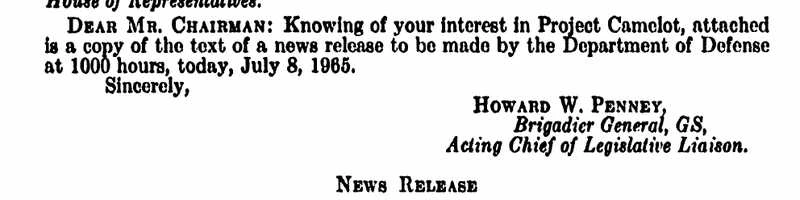
During 1965, when it was discovered in the target countries in South America that the project was funded by the U.S. Army, the whole operation was severely criticized, as it came to be an unacceptable imperialist interference; for this reason, Project Camelot was interrupted on July 8, 1965, although it is believed that the studies continued later, albeit in a less evident and with great discretion.
At that historical moment (towards the end of the 1950s) the army proved to be very interested in counterinsurgency studies, based on the psychology of the crowd and on the social context of the target countries; it was in that context that the so-called "Smithsonian group", made up of scholars and intellectuals connected to large American companies and universities, promoted the ideas that led to the establishment of Project Camelot. It was in fact in a document drafted for the "Smithsonian group" in 1962 that Princeton professor Harry Eckstein wrote:
There is practically no limit to the research that can be, and ought to be, undertaken on the subject of internal war. In a sense, the study of internal war is commensurate with the whole study of society, even peaceable society, for anything that increases our knowledge of social order can potentially increase our understanding of civil disorder.

What were the target countries of Project Camelot ?
Apparently, the research focused on the following geographical areas:
- Argentina
- Bolivia
- Brazil
- Colombia
- Cuba
- Dominican Republic
- El Salvador
- Guatemala
- Mexico
- Paraguay
- Peru
- Venezuela
- Egypt
- Iran
- Turkey
- Korea
- Indonesia
- Malaysia
- Thailand
- France
- Greece
- Nigeria
It is assumed that the investment initially earmarked for Project Camelot was around 4 or 6 million dollars; for analysis and scientific studies, the army relied on the Special Operations Research Organization (SORO), an agency of the American University that is responsible for carrying out many researches commissioned by the United States Army.
These studies served to find information on the military complexes of the target countries and to have a precise overview of the political and social contexts; these data would therefore have allowed the army to intervene promptly, if not even preventively, in the face of militarily relevant situations.
However, the doubts related to an action that someone defines imperialist and that may appear as an unwanted interference by a foreign military power remain legitimate.
[...](the Free World's security could be endangered) not only by a nuclear attack, but also by being slowly nibbled away at the periphery, regardless of our strategic power, by forces of subversion, infiltration, intimidation, indirect or non-overt aggression, internal revolution, diplomatic blackmail, guerrilla warfare or a series of limited wars.
-John F. Kennedy
Resources related to Project Camelot:
- Wikipedia
- Regional Studies Association
- APA PsychNet
Cover image by U.S. Government Printing Office
Article image by U.S. Government Printing Office
Search in the archive:
counterinsurgency
imperialism
kennedy
latin america
mass control
military
politics
project camelot
psychology
us army
us government