


Malcolm X is considered one of the main figures in post-World War II United States history and together with Martin Luther King, one of the most important exponents of the black civil rights movement.
Both died murdered.
Malcolm X, Malcolm Little in the civil register, was born in 1925 in Omaha, Nebraska.
His father, Earl Little, was a Baptist pastor while his mother, Louise Norton, was an immigrant from Grenada, an island that belonged to the British Empire at the time.
Both his parents had joined the Universal Negro Improvement Association, the pan-Africanist black liberation movement, founded in 1914 by Jamaican politician Marcus Garvey.
He grew up in a family so poor that, often, his mother could cook only street weeds at dinner and his childhood was deeply marked by two terrible events: the murder of his father attributed to the Ku Klux Klan (Earl was found guilty of preaching in black ghetto neighborhoods) when he was six years old and her mother's subsequent mental health problems forced her to be admitted to a psychiatric clinic.
He become a pusher, then leader of a gang of thieves in Detroit and Harlem.
In 1946 he was arrested for several apartment thefts and sentenced to eight years in prison at Charlestown State Prison, where he met the Nation Of Islam (NOI), a group of black supremacists who preached black emancipation through an original interpretation of the Islamic religion calling for the creation of a separate black nation within the United States, and the figure of its leader, Elijah Muhammad, who determined his conversion to that vision of Islam.
To Islam, Malcolm Little of Omaha, arrived after having reinvented himself several times in correspondence with as many changes of identity: Jack Carlton, Detroit Red (when he dyed his hair red), Satan, El-Hajj Malik El-Shabazz.
After moving to the Norfolk Prison Colony in Massachusetts, Malcolm X spent most of his time reading Herodotus, Kant, Nietzsche and studying African American history so when he came out of prison in 1952, he became an important member of the organization, as well as one of the its religious leaders.
In these years, in addition to offering his militant commitment to civil rights, he began to identify himself as "Malcolm X" by adopting the X, a symbol of rebellion against surnames that had been affixed to slaves by white masters.
At the time his activism was very intense, so much so that in one of his most famous speeches, he declared that black people in the United States had to fight for their rights "with all the necessary means": among the teachings practiced by the Islamic Nation, in fact, there was the supremacy of blacks over whites and the idea that all whites were intrinsically evil or, in any case, guilty of the oppression of blacks.
For this reason Malcolm X was always very hostile to the other great leader of the civil rights movement, Martin Luther King who considered an "instrument" of the repression of the whites, criticizing his ideas on the non-violence that he said would favor the game of the oppressor preventing blacks from reacting.
He sided against the March on Washington, one of the largest civil rights demonstrations in the history of the United States, held in August 1963, which he himself called the "Farce on Washington".
In 1964, just over a year before his death, Malcolm X announced that he had ended his relationship with NOI: two years earlier he had learned that the leader of the organization, Elijah Muhammed, had several pending lawsuits with two of his secretaries who asked him to recognize his children from illegitimate relationships.
Malcolm X lost faith in Muhammed and began to move away from the group.
The feeling of distrust between the two was actually mutual: Muhammed envied Malcolm X's celebrity so much that he decided to suspend him from the group after he had given an unauthorized interview: in response Malcolm X resigned definitively.
After leaving the organization, he made a pilgrimage to Mecca which changed him a lot: he began to no longer consider all whites as enemies and said that having seen praying together with Muslims with dark and light skin, blond or black hair, the he had taught new ways to solve the problem of black rights in the United States.
In April 1964 he began a long journey to various countries of the world returning to the United States in February 1965.
Malcolm and his family survived a bomb attack on their home on February 14, 1965 and only a few days later he was killed in the Audubon Ballroom in New York by members of the Islamic Nation, Talmadge Hayer aka Thomas Hagan, Muhammad Abdul Aziz alias Norman 3X Butler and Khalil Islam aka Thomas 15X Johnson, hit by 16 bullets (some say 7, others 21) fired from different weapons, in front of the eyes of his wife and four children.
He was only 39 years old.
On February 21, 1965, on the day of a violent death that he himself had foreseen and announced, Malcolm X carried many secrets to his grave: starting with the "real" identity of his assassins and of their instigators.
Scholars and historians have raised questions about Malcolm’s death for years: some have alleged, furthermore, that law enforcement was well aware that Malcolm’s life was in danger but that, because the government had such an interest in undermining his work, they did not intervene to help him, others have suggested that the government’s refusal to investigate the other suspects named by Hayer is evidence of a “more sinister” role in the assassination.
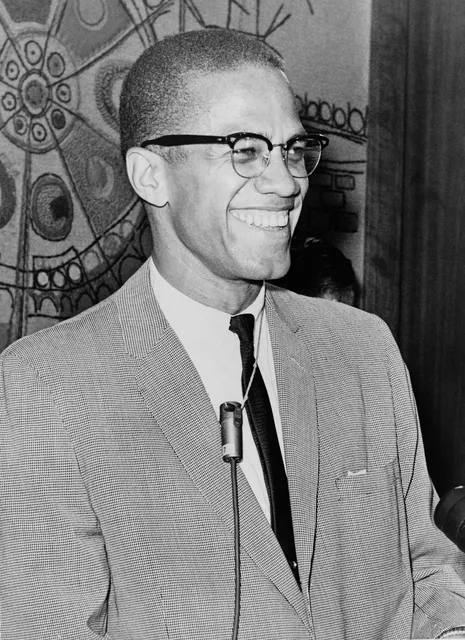
Manning Marable, a professor of African American studies at Columbia University, author of the biography "Malcolm X. A Life of Reinvention", declares that there has been no real and only conspiracy to kill Malcolm, but rather a convergence of interests in its elimination. Why did the policemen literally disappear at the Audubon Ballroom that day? Why wasn't Malcolm X adequately protected? His bodyguards carried no weapons and there were no searches at the entrance.
According to Marable, the first to benefit from the deadly intrigue would be the New York Police Department and its political section, the Boss (Bureau of special services), an office that had infiltrated both the Malcolm organization and the Nation Of Islam. The FBI was also interested in his elimination: he wanted to get him out of the way as soon as possible and marked him tight, not surprisingly Gene Roberts, one of the security officers of Malcolm X, was an undercover policeman. According to the district attorney, at least three other undercover police officers are present at the Audubon Ballroom. None knew the identity of the other two. The Nation of Islam also welcomed the demise of the black leader: Marble claims there are unknowns about the role of Lynwood X, one of the Nation's New Jersey leaders, who sat in the front row at the Audubon Ballroom. He had arrived early to attend the demonstration, and then taken aside by Benjamin 2X, a close associate of Malcolm, and Ruben X Francis, head of security. Lynwood will say he only spoke about Malcolm's upcoming speech, his presence that day may have been more relevant than that of a mere spectator.
Thomas Hagan himself was shot with a pistol by Ruben X, while fleeing after shooting Malcolm X: years later he confessed to his imam, in prison, that the fatal appointment at the Audubon Ballroom was preceded by a meticulous preparation of a week.
Some members of the Nation of Islam know in detail the preparations made by the two Malcolm organizations for the demonstration.
Finally there was a third "pole" interested in Malcolm’s death: some members of his own organizations.
Several of them were upset by the changes introduced, there were tensions between Oaau (Organization of Afro-American Unity, a Pan-Africanist organization founded by Malcolm X in 1964, modeled on the Organisation of African Unity with the purpose of fighting for the human rights of African Americans and promote cooperation among Africans and people of African descent in the Americas) and Muslim Mosque Incorporated (the Islamic organization formed by Malcolm X after he left the Nation of Islam).
Many men and women had left the Nation of Islam to follow Malcolm, whose political ideology, however, was constantly evolving.
Alongside the themes of self-determination and black nationalism, Malcolm adopted a pan-African and internationalist perspective and abjured the positions of radical patriarchal sexism that he had previously supported as a member of the nation, starting instead to promote the advancement of women in the leadership of the Oaau, something that the brothers of the Muslim Mosque do not like absolutely.
In addition, Malcolm, had now become the symbol of urban black America, of his indignation against the structural racism of society as well as the first prominent character to attack the role of the United States in Southeast Asia by submitting to the Korean War in 50 (declaring, however, "Communist") and the Vietnam War before most Americans.
For these reasons, the biographer Marable says he is convinced that Norman Butler and Robert Johnson, captured that day with Hagan, have nothing to do with it, that the real murderers of Malcolm X have not been identified or condemned and that it is essential to be government documents still secretly disclosed in this regard have been made public.
Then there are those who suspect of his circle of collaborators, some of the FBI and, in addition, others who accuse organized crime and drug trafficking who, thanks to Malcolm X, had suffered a sharp drop in business.
Recently, one of Malcolm's daughters, Qubilah Shabazz, accused the current head of the Nation of Islam, Louis Farrakhan, of being the instigator of the assassination.
In May 1995 Farrakhan admitted for the first time the involvement of his organization in the murder of Malcolm X, calling the government to co-responsibility and accusing him of having exploited ignorance and fanaticism in the ranks of the Nation of Islam and the same followers of Malcolm and thus creating a climate conducive to his death. An attempt to minimize his role in the assassination which, however, is not reconciled with the terrible attacks that the Nation of Islam had made to Malcolm, when he had detached himself to found Oaau and Mulsim Mosque Inc., in an attempt to sensitize blacks on government responsibilities in sabotaging their liberation struggle.
Yet it has never sparked the widespread obsessive interest of the Kennedy assassination or the equally brazen killing of Tupac Shakur the case has long tempted scholars, who see a conspiracy hidden in unreleased government documents attempts to reopen the case — to uncover the possible roles of the F.B.I., New York Police Department and the Nation of Islam leadership, including Louis Farrakhan — have gotten nowhere. A detective on the case, Anthony V. Bouza, wrote flatly a few years ago, “The investigation was botched.”
What is certain, to date, is that Malcolm X was becoming a truly dangerous character in the eyes of the US ruling elite.
If he had lived longer and had been able to define his ideas more fully, he could have given birth to an uncompromising movement against racial oppression behind candid anti-capitalist positions.
It was just what the US capitalist class, which was already witnessing the radicalization of the black liberation movement, was afraid above all else.
Malcolm X became a serious problem not only for the US ruling class but also for the leaders of the black bourgeoisie - among them the Nation of Islam - who were always bitterly criticized by him.
His controversial and highly uncompromising ideas combined with his vitriolic statements (his comment on Kennedy's assassination "chickens coming home to roost never did make me sad; they've always made me glad." was famous) earned him a lot of enemies.
“When a person places the proper value on freedom, there is nothing under the sun that he will not do to acquire that freedom. Whenever you hear a man saying he wants freedom, but in the next breath he is going to tell you what he won’t do to get it, or what he doesn’t believe in doing in order to get it, he doesn’t believe in freedom.
A man who believes in freedom will do anything under the sun to acquire…or preserve his freedom.”-Malcom X
Resources related to What’s behind Malcolm X’s death?
- NEW YORK Amsterdam News
- Wikipedia
- In defence of Marxism
- NY Times
Cover Image by Robert Templeton
Search in the archive:
2pak
afro american
audubon ballroom
black civil rights
celebrities conspiracy
cia conspiracy
civil rights
el-hajj malik el-shabazz
elijah muhammed
fbi conspiracy
freedom
government conspiracy
jfk
kukluxclan
malcom little
malcom x
marthin luther king
murder
muslim mosque incorporated
nation of islam
oaau
racial oppression
tupac shakur